History
At Leighterton Primary School, we see history as a key subject for stimulating the children’s interest and understanding about the lives of people who lived in the past. The past influences all aspects of our lives. It shapes the customs and beliefs of the communities to which we belong. Learning about the past and the methods used to study it helps pupils to make sense of the world in which they live and to value their own and other people’s cultures.
“A people without the knowledge of their past history, origin and culture is like a tree without roots.” Marcus Garvey
National Curriculum Purpose of Study:
A high-quality history education will help pupils gain a coherent knowledge and understanding of Britain’s past and that of the wider world. It should inspire pupils’ curiosity to know more about the past. Teaching should equip pupils to ask perceptive questions, think critically, weigh evidence, sift arguments, and develop perspective and judgement. History helps pupils to understand the complexity of people’s lives, the process of change, the diversity of societies and relationships between different groups, as well as their own identity and the challenges of their time.
History at Leighterton Primary School
History has always been a valued part of life at Leighterton Primary School. Our own school’s heritage, along with the rich history of the surrounding area, provides a meaningful foundation for children’s learning. We make full use of local resources and historical features to help pupils develop a strong sense of place and an appreciation of their community’s past.
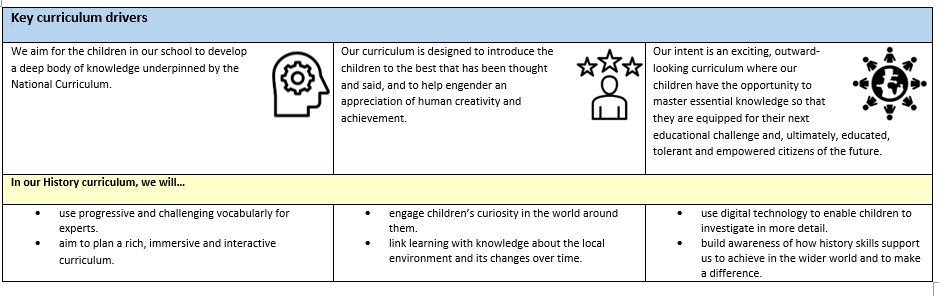
Our history curriculum is guided by the National Curriculum and carefully sequenced to ensure that learning builds securely over time. Topics reflect children’s interests, the local context, and key historical concepts. Throughout their time at Leighterton, pupils are encouraged to:
- develop a coherent understanding of Britain’s past and the wider world;
- ask thoughtful questions, think critically, and evaluate evidence;
- understand changes over time, the diversity of societies, and the connections between different groups and periods.
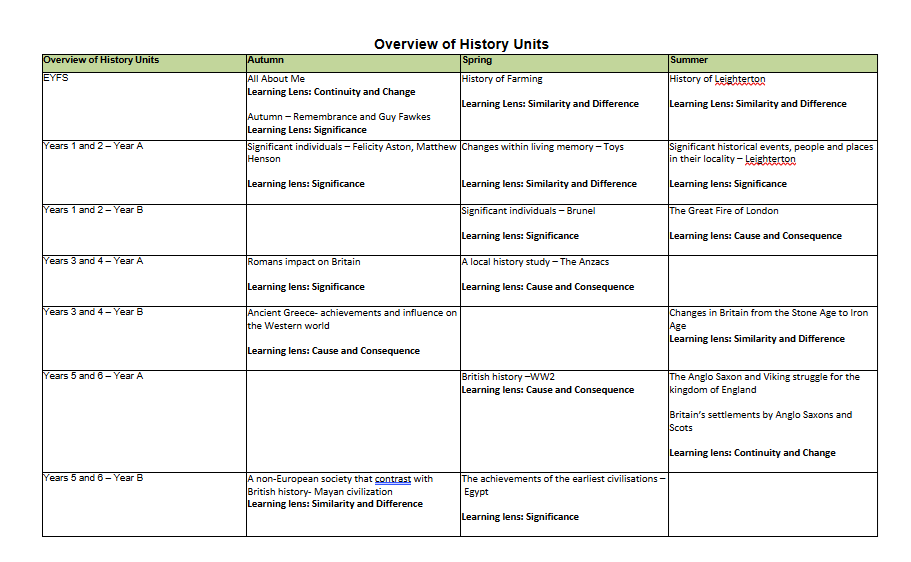
History is taught in blocks within a two-year rolling programme to provide depth and focus. Each unit is explored through one of five learning lenses: Significance, Cause and Consequence, Similarity, Difference, and Continuity and Change. These lenses help pupils build secure historical knowledge and develop strong analytical skills.
By the end of Year 6, children have a chronological understanding of British history from the Stone Age to the present day and can make meaningful comparisons across time periods. Their learning is enriched by studies of world civilisations, such as Ancient Greece and Ancient Egypt, as well as local history topics—for example, the role of the ANZACs in our area.
Assessment is low stakes and focuses on meaningful end of unit outcomes that demonstrate children’s grasp of key knowledge. Our curriculum is designed to be inclusive, challenging, and knowledge rich, enabling all pupils to succeed and to support one another.
EYFS History
In the Early Years Foundation Stage at Leighterton Primary School, children begin to develop an understanding of history through the Understanding the World area of learning. Rather than studying historical periods directly, pupils explore ideas that help them make sense of the past and how it relates to their own lives.
Through play, stories, discussions, and real-life experiences, children learn to:
- talk about events in their own lives and the lives of people familiar to them;
- recognise that the past is different from the present;
- explore how people, places, and objects have changed over time;
- use vocabulary linked to time (e.g., yesterday, long ago, before, now);
- develop curiosity about the world around them.
We make full use of the school grounds and local area to support children’s understanding, introducing them to important local features and traditions. High-quality books, artefacts, and role‑play experiences help children build early historical awareness in a meaningful and enjoyable way.
By the end of Reception, children have begun to develop the foundation skills needed for history in Key Stage 1: noticing change, making simple comparisons, asking questions, and talking about the past with increasing confidence.
In every learning journey, chronological knowledge, disciplinary knowledge and substantive concepts are developed.
Some or all of the following are considered:
- Chronology – placing the period within a timeline. At Leighterton Primary School, the following timeline is used consistently to provide historical context to the period being studied. (Chronological Knowledge)
- Historical evidence – primary and secondary sources and how historians interpret the past (Disciplinary Knowledge)
- Social history – including the social roles of different groups of people within a civilisation: rich and poor; women and men
- Political history – including the power holders and the idea of Empire and invasion
- Economic history – trade, industry and technology
- Cultural history – including the belief systems and key achievements of a civilisation
- Each unit ends with independent application allowing the children opportunities to apply the knowledge they have learnt to a written or oral presentation. This may involve the use of IT to record videos or presentations.
These are explored through developing an understanding of historical concepts through consistent learning lenses:
- Continuity and change
- Cause and consequence
- Similarity
- Difference
- Significance
Children will be taught to frame historically valid questions and create their own structured accounts, including written narratives and analyses, oracy and through technology
Overview of History Units