Science
Rooted in optimism, ambition and kindness, we grow together.
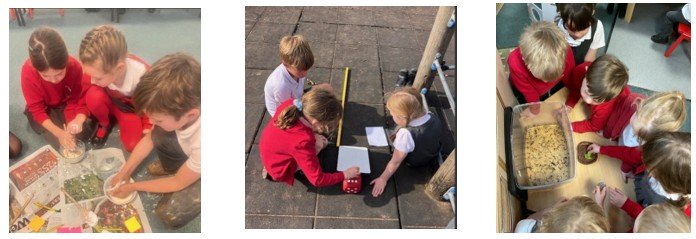
At Leighterton Primary School, though science we aim to stimulate a child’s curiosity in finding out why things happen in the way they do. We aim to teach methods of enquiry and investigation to stimulate rational thought. Children learn to ask scientific questions and begin to appreciate the way science will affect their future.
‘Science is fun. Science is curiosity. We all have natural curiosity. Science is a process of investigating. It’s posing questions and coming up with a method. It’s delving in.’
Sally Ride, 1951-2012, astronaut and physicist
‘A high-quality science education provides the foundations for understanding the world through the specific disciplines of biology, chemistry and physics. Science has changed our lives and is vital to the world’s future prosperity, and all pupils should be taught essential aspects of the knowledge, methods, processes and uses of science. Through building up a body of key foundational knowledge and concepts, pupils should be encouraged to recognise the power of rational explanation and develop a sense of excitement and curiosity about natural phenomena. They should be encouraged to understand how science can be used to explain what is occurring, predict how things will behave, and analyse causes.’ (National Curriculum, September 2013)
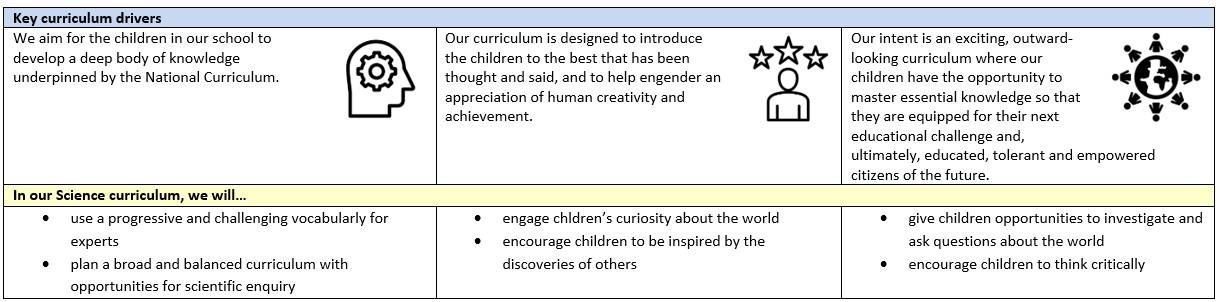
The Science curriculum at Leighterton Primary School is built around the statutory content of the National Curriculum and the Early Years Foundation Stage Curriculum.
National Curriculum Purpose of Study:
A high-quality science education provides the foundations for understanding the world through the specific disciplines of biology, chemistry and physics. Science has changed our lives and is vital to the world’s future prosperity, and all pupils should be taught essential aspects of the knowledge, methods, processes and uses of science. Through building up a body of key foundational knowledge and concepts, pupils should be encouraged to recognise the power of rational explanation and develop a sense of excitement and curiosity about natural phenomena. They should be encouraged to understand how science can be used to explain what is occurring, predict how things will behave, and analyse causes.
National Curriculum Aims:
The national curriculum for science aims to ensure that all pupils:
- develop scientific knowledge and conceptual understanding through the specific disciplines of biology, chemistry and physics
- develop understanding of the nature, processes and methods of science through different types of science enquiries that help them to answer scientific questions about the world around them
- are equipped with the scientific knowledge required to understand the uses and implications of science, today and for the future
We aim to enable children to:
- develop scientific knowledge and understanding
- develop scientific enquiry skills
- ask questions about the world they live in and make simple predictions about what might happen if…
- look carefully at the world around them and use their 5 senses to say what it is like
- be able to use observations to sort and measure things
- record their findings in drawings, charts, words and tables
- explain how to make their test fair and explain why it is fair
- say what happened and explain trends in their results
- have an everyday working knowledge of Science so they can apply it to their everyday lives
- make use of IT, English and Mathematical skills
- work safely
Science is a core subject; the National Curriculum programmes of study include:
- KS1: working scientifically, plants, animals including humans, everyday materials, seasonal changes and living things and their habitats
- LKS2: working scientifically, plants, animals including humans, rocks, light, forces and magnets, living things and their habitats, states of matter, sound and electricity.
- UKS2: working scientifically, living things and their habitats, animals including humans, properties and changes of materials, Earth and space, forces, evolution and inheritance, light and electricity.
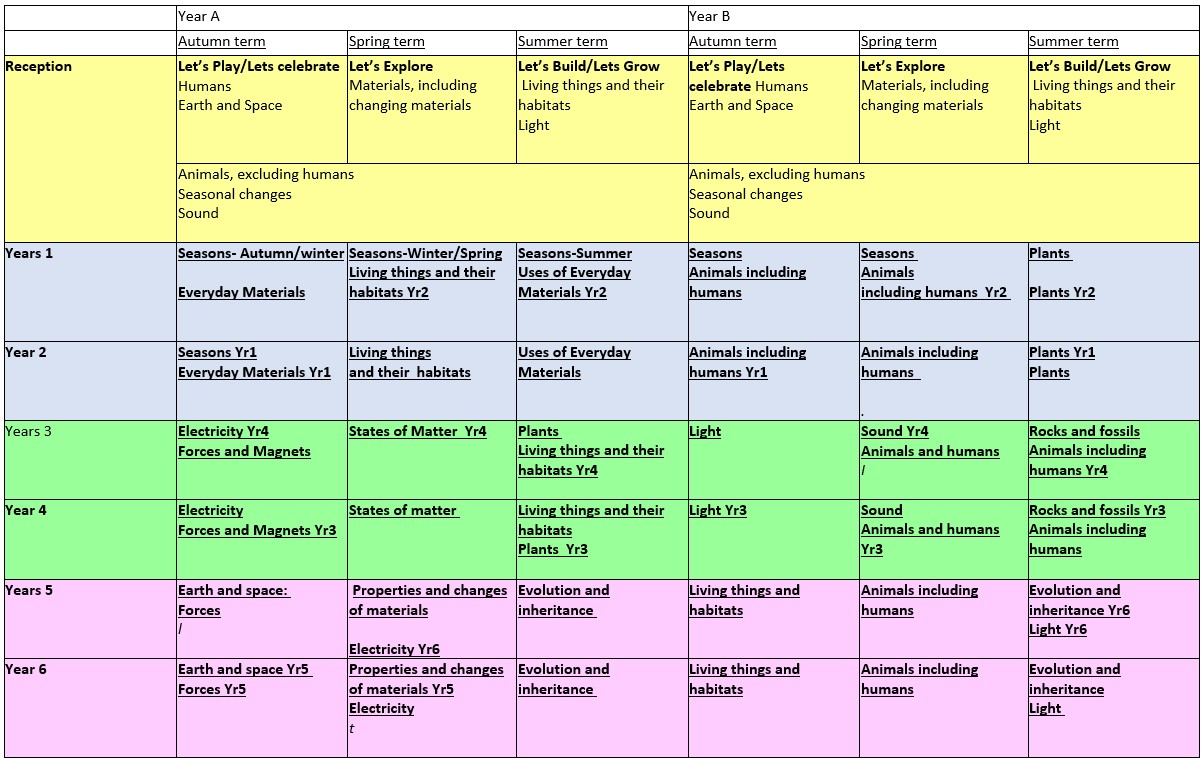
At our school, the content of the curriculum is taught around a two-year rolling programme.
There is a range of resources to support the teaching of science across the school including beakers, electrical equipment, rock samples, magnets etc. Each classroom has a copy of ‘Be Safe!’ so staff can use science and technology to teach health and safety. It includes advice on risk assessment, food hygiene, studies outside the classroom, advice on making things safely, safe use of chemicals, animals and plants, and managing health and safety.
Visits and visitors are often planned to enhance learning experiences, such as visits to We The Curious and Butterfly Farm. We also take part in interschool events such as science experience days at Westonbirt School.
Early Years Foundation Stage
Within the EYFS, the specific area of ‘Understanding the World’ encompasses a range of early scientific skills and knowledge. It involves guiding children to make sense of their physical world and their community through opportunities to explore, observe and find out about people, places, technology and the environment.
In the Early Years Foundation Stage, Understanding the World is broken down into three aspects:
- Past and Present ELG Children at the expected level of development will:
- Talk about the lives of the people around them and their roles in society;
- Know some similarities and differences between things in the past and now, drawing on their experiences and what has been read in class;
- Understand the past through settings, characters and events encountered in books read in class and storytelling;
- People Culture and Communities ELG Children at the expected level of development will:
- Describe their immediate environment using knowledge from observation, discussion, stories, non-fiction texts, and maps;
- Know some similarities and differences between different religious and cultural communities in this country, drawing on their experiences and what has been read in class;
- Explain some similarities and differences between life in this country and life in other countries, drawing on knowledge from stories, non-fiction texts and – when appropriate – maps.
- The Natural World ELG Children at the expected level of development will:
- Explore the natural world around them, making observations and drawing pictures of animals and plants;
- Know some similarities and differences between the natural world around them and contrasting environments, drawing on their experiences and what has been read in class;
- Understand some important processes and changes in the natural world around them, including the seasons and changing states of matter.
Understanding of the world develops as children take notice of everything around them including places, and all the things within them such as trees in the natural environment, and roads and traffic in the built environment. This aspect also focuses on learning about cause and effect and is developed through having conversations with adults and other children about the things they observe.
Learning in the EYFS is resourced and facilitated to ensure that opportunities for early scientific skills and knowledge are developed. Essential knowledge to be taught is identified on the scheme of work.
Our science assessments are built around key learning lenses that help pupils develop strong scientific thinking and enquiry skills. Children learn to ask purposeful questions, plan effective enquiries, and make thoughtful predictions based on prior knowledge. Throughout practical work, they practise gathering accurate data, recording their findings clearly, and presenting results in ways that allow patterns to be easily identified. Using this evidence, pupils draw well‑reasoned conclusions and evaluate their enquiry, reflecting on the reliability of their methods and the validity of their results. These learning lenses ensure that science assessment goes beyond knowledge recall, focusing instead on nurturing curious, reflective and capable young scientists.