Geography
Rooted in optimism, ambition and kindness, we grow together.
At Leighterton Primary School, we see geography as a key subject for inspiring in children a curiosity and fascination about the world and its people.
‘If geography itself has any significance it is that we are made to lift out eyes from our small provincial selves to the whole complex and magnificent world.’ – Reportedly Richard Burton (1821-1890) to the Royal Geographical Society
‘Geography explains the past, illuminates the present and prepares us for the future. What could be more important than that?’ – Michael Palin, 2007
The teaching of a high-quality geography education ‘should equip pupils with knowledge about diverse places, people, resources and natural and human environments, together with a deep understanding of the Earth’s key physical and human processes. As pupils progress, their growing knowledge about the world should help them to deepen their understanding of the interaction between physical and human processes, and of the formation and use of landscapes and environments. Geographical knowledge, understanding and skills provide the frameworks and approaches that explain how the Earth’s features at different scales are shaped, interconnected and change over time.’ (National Curriculum in England, September 2013)
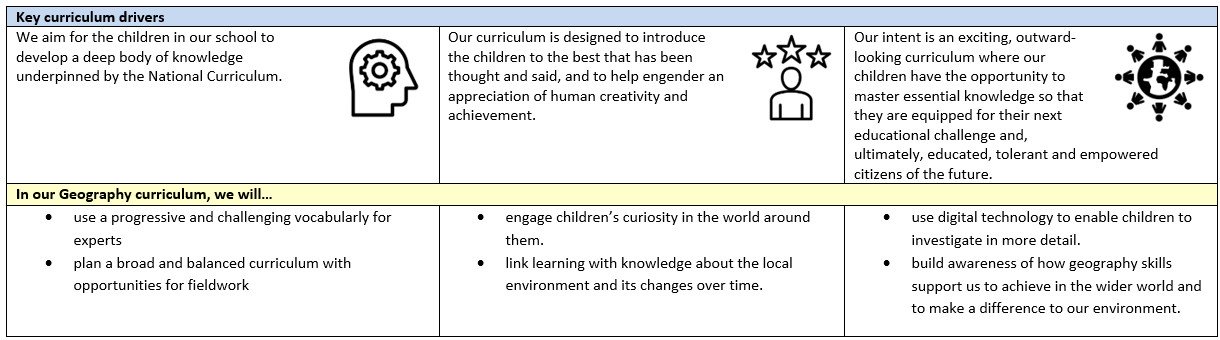
Our overarching aim for geography is to promote a high level of understanding of geographical skills, knowledge, vocabulary and processes, through a curriculum which engenders excitement, creativity and critical thinking about the world that equips young people to make their own way in it. We are committed to providing children with opportunities to investigate their local area so that they are able to develop a sense of place and find out what makes our local area unique and special. Within our curriculum we also investigate a range of places, providing children with the essential characteristics of curious geographers with a real sense of curiosity about the world and its diverse places, people, resources and natural and human environments, together with a deep understanding of the Earth’s key physical and human processes.
National Curriculum Purpose of Study:
A high-quality geography education should inspire pupils with curiosity and fascination about the world and its people that will remain with them for the rest of their lives. Teaching should equip pupils with knowledge about diverse places, people, resources and natural and human environments, together with a deep understanding of the Earth’s key physical and human processes. As pupils progress, their growing knowledge about the world should help them to deepen their understanding of the interaction between physical and human processes, and of the formation and use of landscapes and environments. Geographical knowledge, understanding and skills provide the frameworks and approaches that explain how the Earth’s features at different scales are shaped, interconnected, and change over time.
National Curriculum Aims:
The national curriculum for geography aims to ensure that all pupils:
- develop contextual knowledge of the location of globally significant places – both terrestrial and marine – including their defining physical and human characteristics and how these provide a geographical context for understanding the actions of processes
- understand the processes that give rise to key physical and human geographical features of the world, how these are interdependent and how they bring about spatial variation and change over time
- are competent in the geographical skills needed to:
- collect, analyse and communicate with a range of data gathered through experiences of fieldwork that deepen their understanding of geographical processes
- interpret a range of sources of geographical information, including maps, diagrams, globes, aerial photographs and Geographical Information Systems (GIS)
- communicate geographical information in a variety of ways, including through maps, numerical and quantitative skills and writing at length.
The Geography curriculum at Leighterton Primary School is built around the statutory content of the National Curriculum and the Early Years Foundation Stage Curriculum. Geography is a foundation subject; the National Curriculum programmes of study require children to be taught locational knowledge, place knowledge, human and physical geography, and geographical skills and fieldwork.
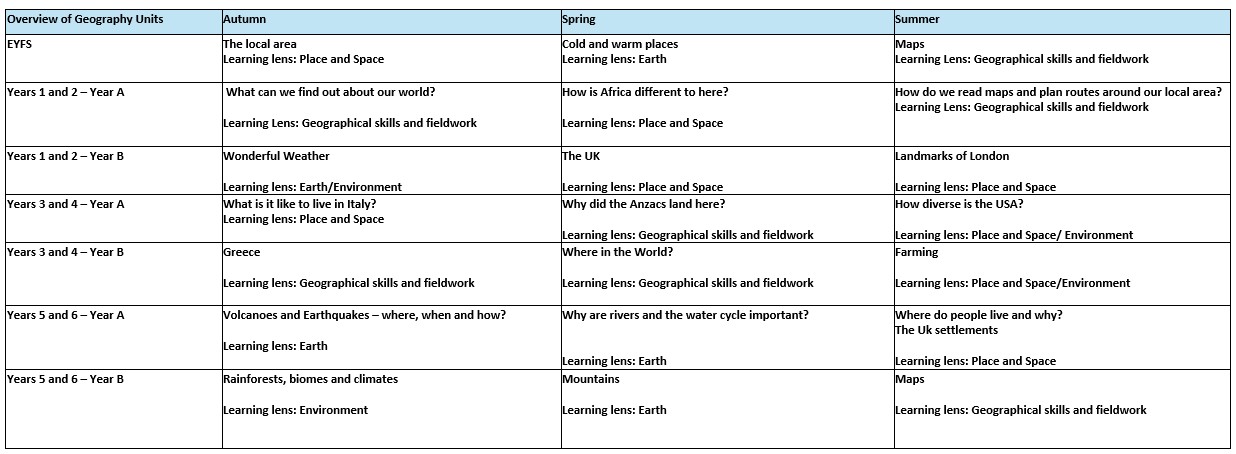
Geography is taught in blocks within a two-year rolling programme to provide depth and focus. Each unit is explored through one of four learning lenses: Geographical skills and fieldwork, Place and Space, Earth Systems and Environment. These lenses help pupils build secure geographical knowledge and develop strong analytical skills. In every learning journey, disciplinary knowledge is also developed so that children develop the habits of thinking geographically. Some or all of the following geographical concepts are considered:
There is a range of resources to support the teaching of Geography across the school. These include maps, globes, technology, compasses and measuring equipment. Use is made of the Schools Library Service for reading materials.
Early Years Foundation Stage
Within the Early Years Foundation Stage, the specific area of ‘Understanding the World’ encompasses a range of early geographical skills and knowledge. It involves guiding children to make sense of their physical world and their community through opportunities to explore, observe and find out about people, places, technology and the environment.
In the Revised Early Years Foundation Stage, Understanding the World is broken down into three aspects:
- People and communities: children talk about past and present events in their own lives and in the lives of family members. They know that other children don’t always enjoy the same things, and are sensitive to this. They know about similarities and differences between themselves and others, and among families, communities and traditions.
- The world: children know about similarities and differences in relation to places, objects, materials and living things. They talk about the features of their own immediate environment and how environments might vary from one another. They make observations of animals and plants and explain why some things occur, and talk about changes.
- Technology: children recognise that a range of technology is used in places such as homes and schools. They select and use technology for particular purposes.
Understanding of the world develops as children take notice of everything around them including places, and all the things within them such as trees in the natural environment, and roads and traffic in the built environment. Finding out about places begins initially when a child learns about their own home and the things nearby, then later as children notice things on journeys to and from home – such as the sequence of the traffic lights or names on street signs. This awareness is extended by visiting places and finding out about different elements of environments in books, on TV and through using other technology. This aspect also focuses on learning about cause and effect and is developed through having conversations with adults and other children about the things they observe.
Continuous provision in the EYFS is resourced and facilitated to ensure that opportunities for early geographical skills and knowledge are developed.