

Music
Rooted in optimism, ambition and kindness, we grow together.
At Leighterton Primary School, we believe that music enriches the lives of people. Music is a unique way of communicating that can inspire creativity, personal development and motivation. It is a vehicle for personal expression and plays an important part in helping children feel part of a community. Music is an important entitlement to all children at Avening Primary School. We provide opportunities for all children to create, play, perform and enjoy music, to develop the skills to appreciate a wide variety of musical forms, and to begin to make judgements about the quality of music.
“Music gives a soul to the universe, wings to the mind, flight to the imagination and life to everything.” Plato
‘Music is a universal language that embodies one of the highest forms of creativity. A high quality music education should engage and inspire pupils to develop a love of music and their talent as musicians, and so increase their self-confidence, creativity and sense of achievement. As pupils progress, they should develop a critical engagement with music, allowing them to compose, and to listen with discrimination to the best in the musical canon.’(National Curriculum in England, September 2013)
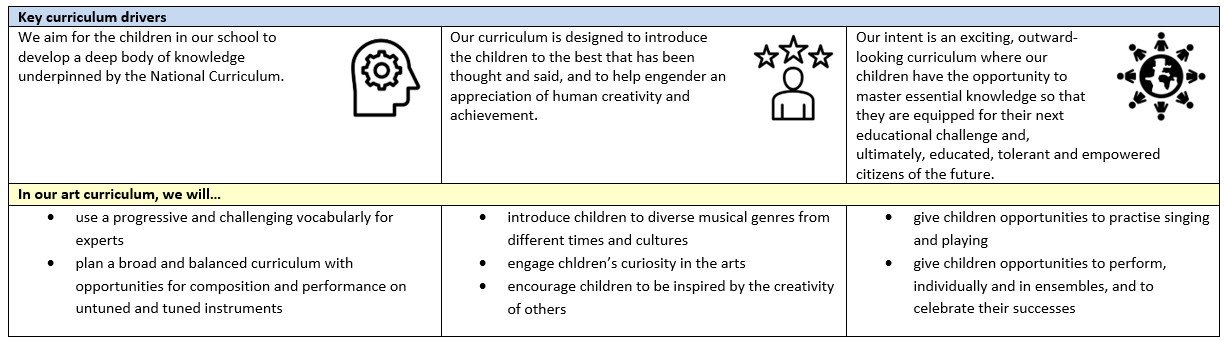
Our overarching aim for Music is to promote a high level of understanding of musical skills and knowledge.
National Curriculum Purpose of Study:
Music is a universal language that embodies one of the highest forms of creativity. A high-quality music education should engage and inspire pupils to develop a love of music and their talent as musicians, and so increase their self-confidence, creativity and sense of achievement. As pupils progress, they should develop a critical engagement with music, allowing them to compose, and to listen with discrimination to the best in the musical canon.
National Curriculum Aims:
The national curriculum for music aims to ensure that all pupils:
- perform, listen to, review and evaluate music across a range of historical periods, genres, styles and traditions, including the works of the great composers and musicians
- learn to sing and to use their voices, to create and compose music on their own and with others, have the opportunity to learn a musical instrument, use technology appropriately and have the opportunity to progress to the next level of musical excellence
- understand and explore how music is created, produced and communicated, including through the inter-related dimensions: pitch, duration, dynamics, tempo, timbre, texture, structure and appropriate musical notations.
At our school, we use Charanga as the core of our scheme of work for the Early Years Foundation Stage. From Year 1, we use Oak National Academy as the core of our scheme of work, supplemented with Charanga and whole class musical tuition.
Our curriculum develops pupils as musicians, fostering a deeper understanding of the subject as a platform for a lifelong connection with music. Through performance, composition and engaged listening, pupils develop their musicianship and experience a diverse range of musicians and styles, enable them to embrace creativity and expression and build their understanding of and confidence in making music both individually and with others. Oak National Academy resources ensures that our curriculum is knowledge and vocabulary rich, sequenced and coherent, evidence-informed, diverse and accessible.
As part of our provision, there is a planned programme of music listened to and appraised in assembly time covering a wide range of genres including classical (e.g. Handel’s Messiah, Beethoven, Bach and Allegri; folk music which tells a story such as ‘The Headscarf Revolutionaries’; world music; and popular music from various eras).
Curriculum coherence
Six threads signpost groups of units that link to one another, that together build a common body of knowledge over time. We use these threads as our ‘learning lenses’ for assessment.

Our threads are:
- Developing our singing voice
- Playing together in an ensemble
- Practising and preparing for a performance
- Creating, composing and improvising
- Notating and sharing music
- Music over time and in different places – covered in each unit
Early Years Foundation Stage
Within the Early Years Foundation Stage, the specific area of ‘Expressive Arts and Design’ encompasses a range of early music skills and knowledge.
In the Revised Early Years Foundation Stage, expressive arts and design involves enabling children to explore and play with a wide range of media and materials, as well as providing opportunities and encouragement for sharing their thoughts, ideas and feelings through a variety of activities in art, music, movement, dance, role-play, and design and technology.
Music reflects the three characteristics of effective teaching and learning in the Early Years Foundation Stage:
- playing and exploring – children investigate and experience things, and ‘have a go’
- active learning – children concentrate and keep on trying if they encounter difficulties, and enjoy achievements
- creating and thinking critically – children have and develop their own ideas, make links between ideas, and develop strategies for doing things
Continuous provision in the EYFS is resourced and facilitated to ensure that opportunities for early musical skills and knowledge are developed.
Within objective-led tasks, children are encouraged to build a repertoire of songs and dances, as well as explore different sounds of instruments.
Extra-curricular activities
At Leighterton Primary School, Music is a key area for enrichment and we encourage as many children as possible to take part in musical activities outside of music lessons.
The Young Voices performance in Birmingham is also a highlight for our singers, seeing children performing in the world’s largest children’s choir – something we see as an importance offer in a small school. Children eligible for the pupil premium are always offered a space on this exciting experience.
As part of our peripatetic offer, we have guitar, violin and piano teachers providing lessons.
The culmination of our work in music is our annual Musical Soirée, which sees children perform on their instruments and singing.
Enrichment
In addition to the cultural enrichment opportunities identified on the scheme of work, an eclectic programme of music is introduced to the children during assemblies, with powerpoint slides about the genre or composer. The music often supports the value in focus, the time of year, or a topic being studied by the children. Recent choices have included folk music by Jonas and Harbottle – The Headscarf Revolutionaries, Vaughan Williams’s ‘The Lark Ascending’, Allegri’s Miserere and One Republic’s ‘Truth to Power’. The children have regular opportunities to hear Handel’s Messiah, as well as other significant composers.
Every year, all children take part in a whole school musical. In EYFS and KS1, this is a nativity; in KS2, a commercial musical is used. This sees all children sing in a group and perform to an audience, with opportunities for solo performances in all Key Stages, as well as percussion accompaniments.


