Religious Education
Rooted in optimism, ambition and kindness, we grow together.
At Leighterton Primary School, we believe that Religious Education (RE) enables children to investigate and reflect on some of the most provoking and challenging questions asked by people about the meaning and purpose of life, with ongoing benefits for an open, articulate and understanding society. Contributing to our school vision, RE provides a space in the curriculum to explore and reflect on some of the major world religions, beliefs about God, what it means to have a faith, issues of right and wrong, and what it means to be human, developing their own spiritual knowledge and understanding.
“In religious education (RE), pupils enter into a rich discourse about the religious and non-religious traditions that have shaped Great Britain and the world… At its best, it is intellectually challenging and personally enriching. It affords pupils both the opportunity to see the religion and non-religion in the world, and the opportunity to make sense of their own place in that world.”
(Ofsted Research Review Series, Religious Education, 2021)
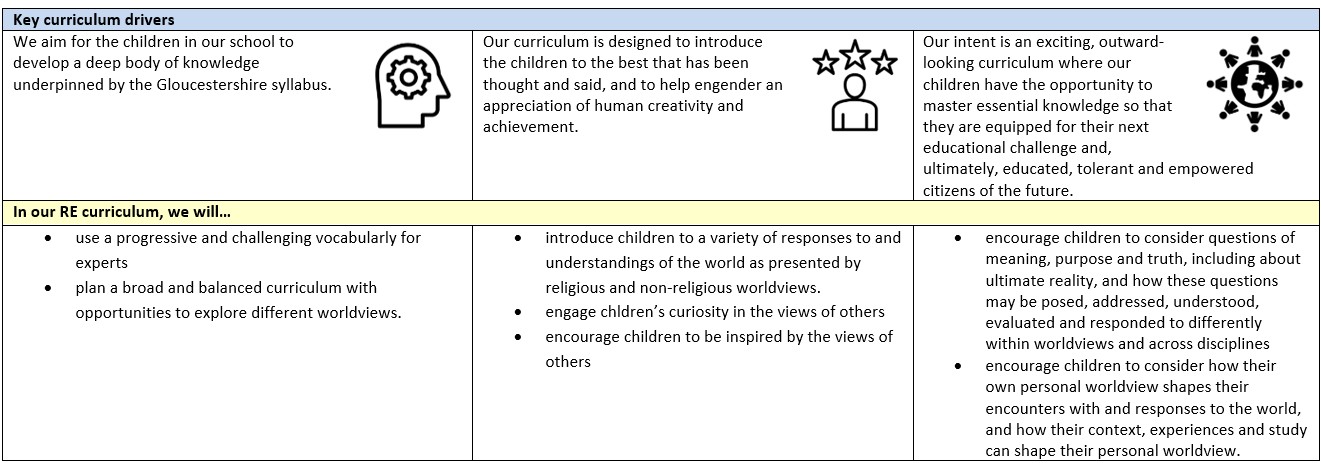
The Gloucestershire syllabus 2025 asserts the importance and value of religious education for all pupils, with on-going benefits for an open, articulate and understanding society.
‘The principal aim for religious education in Gloucestershire is for pupils to understand how worldviews influence people’s lives, including their own, through the study of religious and non-religious worldviews, so that they better understand themselves and the world around them, and become better equipped to contribute to and flourish in society.’
The Gloucester syllabus 2025 states that this principal aim incorporates a religion and worldviews (RW) approach. RE following this approach will help pupils to understand:
- a variety of responses to and understandings of the world as presented by religious and non-religious worldviews
- relationships between beliefs, teachings, forms of expression within organised worldviews, and the lived experience of adherents
- questions of meaning, purpose and truth, including about ultimate reality, and how these questions may be posed, addressed, understood, evaluated and responded to differently within worldviews and across disciplines
- the concepts, language and ways of knowing that help organise and make sense of religion and worldviews
- how to deploy a range of different tools and methods used to investigate religious and non-religious worldviews
- how their own personal worldview shapes their encounters with and responses to the world, and how their context, experiences and study can shape their personal worldview.
Religious Education is unique in the curriculum as it is neither a core or foundation subject. In the 1988 Education Act it states, ‘Religious Education (RE) has equal standing in relation to core subjects of the National Curriculum in that it is compulsory for all pupils’. At Leighterton Primary School, we have adopted the Gloucestershire Agreed Syllabus for RE 2025.
In line with the Gloucestershire Agreed Syllabus for RE 2025, the threefold aim of RE elaborates the principal aim.
The curriculum for RE aims to ensure that all pupils:
- Understand how religious and non-religious worldviews influence people’s lives, so that they can:
- identify and make sense of religious and non-religious beliefs, concepts, teachings and traditions that shape organised, communal and individual worldviews
- explain how and why worldviews both form and express people’s ways of being, behaving and belonging
- explain a range of ways in which worldviews offer responses to fundamental questions, provide guidance and influence people in how to live
- Engage with religious and non-religious worldviews in thoughtful and scholarly ways, so that they can:
- select and use an appropriate range of research methods, weighing up their findings
- recognise how the lived experience of individuals and communities relates to the teachings and traditions of organised religious and non-religious worldviews
- understand the role of dialogue and interpretation in the dynamic development of organised worldviews, and developing their own skills of dialogue and interpretation
- Understand themselves, and others, and their personal worldviews better, so that they can:
- use scholarly methods to come to informed judgements about the answers reached through their study, responding thoughtfully and creatively, giving good reasons for their responses
- draw attention to their own position, and others’, in their learning, both in terms of impact on their encounters and also the effect of the encounters of their own worldviews, articulating beliefs, values and commitments clearly in response
- challenge ideas studied, and allow the ideas studied to challenge their own thinking, being and ways of understanding the world, expressing their critical and personal reflections with increasing clarity and understanding, including potential choices and responses to the world
Organisation and Planning
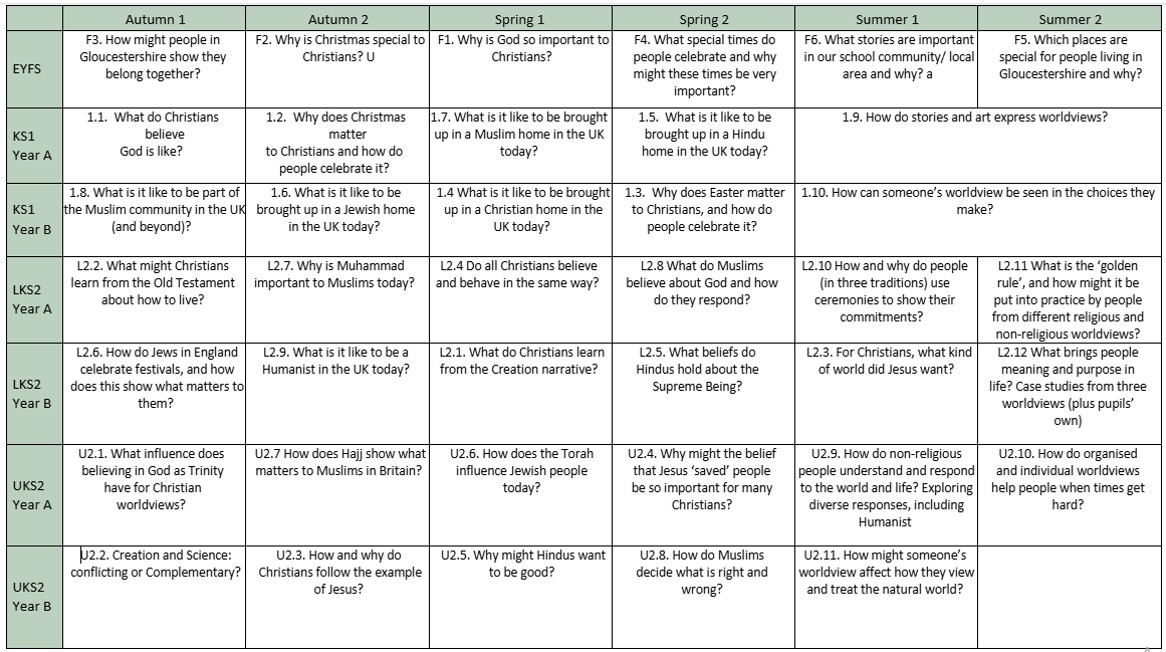
The RE curriculum at Leighterton Primary School is built around the content Gloucestershire Agreed Syllabus for RE, 2025.
At our school, the content of the curriculum is taught around a two-year rolling programme. In accordance with the structure of the Gloucestershire Agreed Syllabus, we have agreed that in the Early Years Foundation Stage and in Key Stage 1, children will be in taught RE for approximately 36 hours over the year, usually in discreet, regular lessons.
In Key Stage 2, RE is taught for approximately 45 hours over the year, again usually in discreet lessons. Within each unit, teachers decide when RE is best taught. Lessons will usually be weekly.
The progressive syllabus ensures that our expectations are sufficiently challenging. We identify a ‘learning lens’, key knowledge and vocabulary, which are shared with the children. These are based on the end of unit outcomes in the Gloucestershire Agreed Syllabus.
Early Years Foundation Stage
The children’s learning in RE supports their development within the specific area of ‘Understanding the World’. It involves guiding children to make sense of their physical world and their community through opportunities to explore, observe and find out about people, places, technology and the environment.
In the Early Years Foundation Stage, Understanding the World is broken down into three aspects:
- Past and Present ELG Children at the expected level of development will:
- Talk about the lives of the people around them and their roles in society;
- Know some similarities and differences between things in the past and now, drawing on their experiences and what has been read in class;
- Understand the past through settings, characters and events encountered in books read in class and storytelling;
- People Culture and Communities ELG Children at the expected level of development will:
- Describe their immediate environment using knowledge from observation, discussion, stories, non-fiction texts, and maps;
- Know some similarities and differences between different religious and cultural communities in this country, drawing on their experiences and what has been read in class;
- Explain some similarities and differences between life in this country and life in other countries, drawing on knowledge from stories, non-fiction texts and – when appropriate – maps.
- The Natural World ELG Children at the expected level of development will:
- Explore the natural world around them, making observations and drawing pictures of animals and plants;
- Know some similarities and differences between the natural world around them and contrasting environments, drawing on their experiences and what has been read in class;
- Understand some important processes and changes in the natural world around them, including the seasons and changing states of matter.
Learning in the EYFS is resourced and facilitated to ensure that opportunities for early RE knowledge and skills are developed.
Extra-Curricular Opportunities
We appreciate the positive impact that local faith communities can have on pupils’ experience in RE. Therefore, this school encourages visits to places of worship and welcomes visitors from different faith communities. We recognise it is vitally important that teachers demonstrate respectful attitudes towards all faiths, modelling the attitudes and responses we would expect from our pupils.