Art
At Leighterton Primary School, Art and Design are seen as a key way of stimulating creativity and imagination, providing visual, tactile and sensory experiences and a special way of understanding and responding to the world. It enables children to communicate what they see, feel and think through the use of colour, texture, form, pattern and different materials and processes. Children become involved in shaping their environments through art and design activities; an appreciation and enjoyment of the visual arts enriches all our lives.
“Art is unquestionably one of the purest and highest elements in human happiness. It trains the mind through the eye, and the eye through the mind. As the sun colours flowers, so does art colour life.”
John Lubbock (1834-1913)
‘Art, craft and design embody some of the highest forms of human creativity. A high-quality art and design education should engage, inspire and challenge pupils, equipping them with the knowledge and skills to experiment, invent and create their own works of art, craft and design. As pupils progress, they should be able to think critically and develop a more rigorous understanding of art and design. They should also know how art and design both reflect and shape our history, and contribute to the culture, creativity and wealth of our nation.’(National Curriculum in England, September 2013)
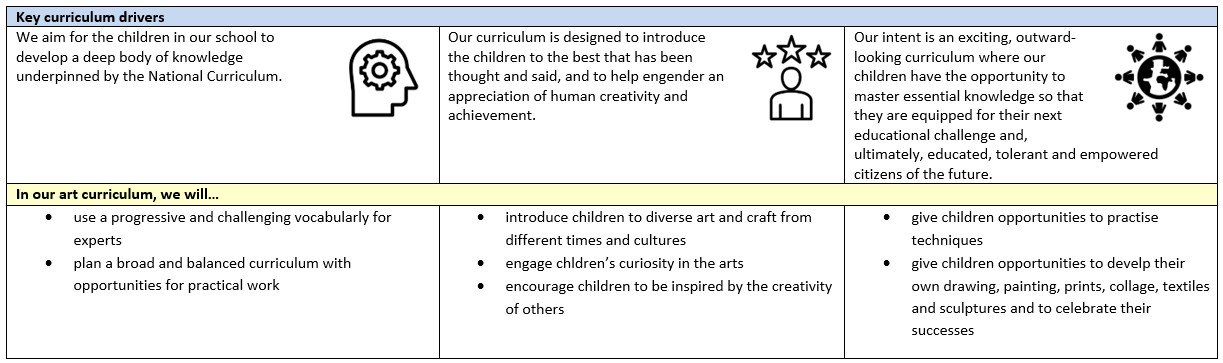
Our overarching aim for Art is to promote a high level of understanding of skills and knowledge, where drawing and painting skills are central in the process of developing works of art using a range of techniques involving collage, sculpture, print-making and textiles. Our starting point is always the works of great artists or craft makers, so that children are able to take inspiration from the greats to help them develop their ideas and learn new techniques.
National Curriculum Purpose of Study:
Art, craft and design embody some of the highest forms of human creativity. A high-quality art and design education should engage, inspire and challenge pupils, equipping them with the knowledge and skills to experiment, invent and create their own works of art, craft and design. As pupils progress, they should be able to think critically and develop a more rigorous understanding of art and design. They should also know how art and design both reflect and shape our history, and contribute to the culture, creativity and wealth of our nation.
National Curriculum Aims:
The national curriculum for art and design aims to ensure that all pupils:
- produce creative work, exploring their ideas and recording their experiences
- become proficient in drawing, painting, sculpture and other art, craft and design techniques
- evaluate and analyse creative works using the language of art, craft and design
- know about great artists, craft makers and designers, and understand the historical and cultural development of their art forms.
The Art curriculum at Leighterton Primary School is built around the statutory content of the 2014 National Curriculum and the Early Years Foundation Stage Curriculum.
Art is a foundation subject; the National Curriculum outlines the knowledge and skills that pupils should be taught:
Key Stage 1 – Pupils should be taught:
- to use a range of materials creatively to design and make products
- to use drawing, painting and sculpture to develop and share their ideas, experiences and imagination
- to develop a wide range of art and design techniques in using colour, pattern, texture, line, shape, form and space
- about the work of a range of artists, craft makers and designers, describing the differences and similarities between different practices and disciplines, and making links to their own work.
Key Stage 2 – Pupils should be taught:
- to develop their techniques, including their control and their use of materials, with creativity, experimentation and an increasing awareness of different kinds of art, craft and design
- to create sketch books to record their observations and use them to review and revisit ideas
- to improve their mastery of art and design techniques, including drawing, painting and sculpture with a range of materials, for example pencil, charcoal, paint, clay
- about great artists, architects and designers in history.
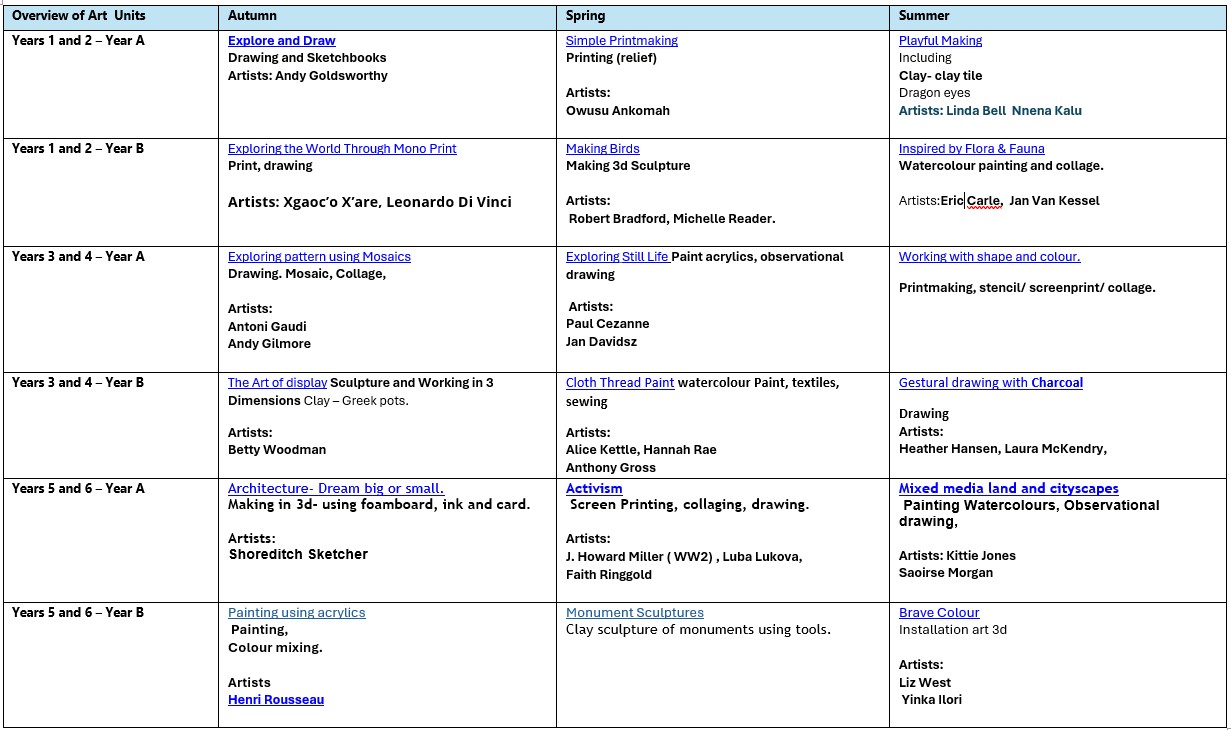
At our school, the content of the curriculum is taught in blocks within a two-year rolling programme to provide depth and focus. Each unit is explored through one of five learning lenses: Drawing, Painting, Sculpture, Collage, Printing and Textiles. These lenses help pupils build secure knowledge and develop strong art techniques.
Early Years Foundation Stage
Within the Early Years Foundation Stage, the specific area of ‘Expressive Arts and Design’ encompasses a range of early art skills and knowledge. In the Early Years Foundation Stage, expressive arts and design involves enabling children to explore and play with a wide range of media and materials, as well as providing opportunities and encouragement for sharing their thoughts, ideas and feelings through a variety of activities in art, music, movement, dance, role-play, and design and technology.
Art reflects the three characteristics of effective teaching and learning in the Early Years Foundation Stage:
- playing and exploring – children investigate and experience things, and ‘have a go’
- active learning – children concentrate and keep on trying if they encounter difficulties, and enjoy achievements
- creating and thinking critically – children have and develop their own ideas, make links between ideas, and develop strategies for doing things
Continuous provision in the EYFS is resourced and facilitated to ensure that opportunities for early art skills and knowledge are developed. We provide a rich environment in which we encourage and value creativity. Within objective-led tasks, children are encouraged to safely use and explore a variety of materials, tools and techniques, experimenting with colour, design, texture, form and function.